Our Work

Work already in motion

From bringing indigenous Master Tracker/Evaluators to the first International CyberTracker meeting to mentorships across the world, the Foundation backs the people who carry tracking knowledge.

Already in motion

Established in 2026, built on work that was already underway

The Tracker Empowerment Foundation was established in 2026 by people already embedded in the global tracking community. The projects below were already in motion before the Foundation had a name, supporting trackers toward certification, funding the research that proves tracking's value to science, and making sure indigenous, local, and community practitioners have a seat at the table.

CyberTracker evaluation in progress in the field.
01 · Flagship Southern Africa · August 2026

First International CyberTracker Evaluators Meeting

The first gathering of CyberTracker Evaluators in the system's 32-year history, in the Kruger Lowveld region of South Africa. Of ~35 attending Evaluators, none were indigenous, not for lack of credentials, but lack of travel and accommodation means. The Foundation raised $14,000 to bring five indigenous Master Trackers from Namibia, Botswana and South Africa, to actively participate in decisions that could change the future of tracker certification.

The meeting is organized by the directors for CyberTracker Conservation; the Foundation receives no financial benefit.

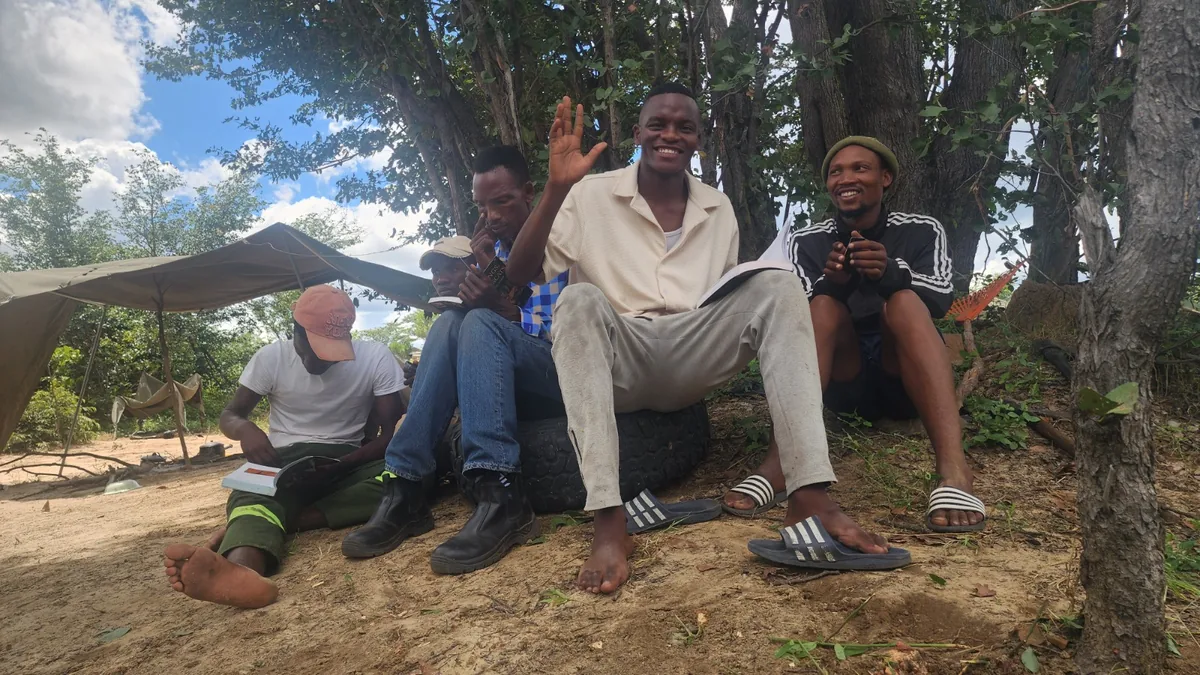
Khwe San community trackers during a training session in Botswana
02 Southern Africa · Ongoing

San Community Tracker Mentorship, Botswana

Working with the Khwe San of Gundigwe, the Foundation funds high-performing candidates toward the ability to formally instruct in the CyberTracker style. Through a pilot program sponsored by the Discovery Wilderness Trust (DWT) in March 2026, candidates earned Secondary Certification with CyberTracker Conservation, the international gold standard for training and certifying trackers. We are raising funds to bring top performing candidates to South Africa to expedite their further advancement and ability to instruct and certify trackers. The goal is twofold: to empower these candidates to award Junior, Adventure and Participatory Awards in their own community as they work toward Senior Tracker certification and formal Evaluatorship, and for CyberTracker Evaluators to return to further certify community members and help them find employment opportunities. The Foundation covers travel, accommodation, and program costs.

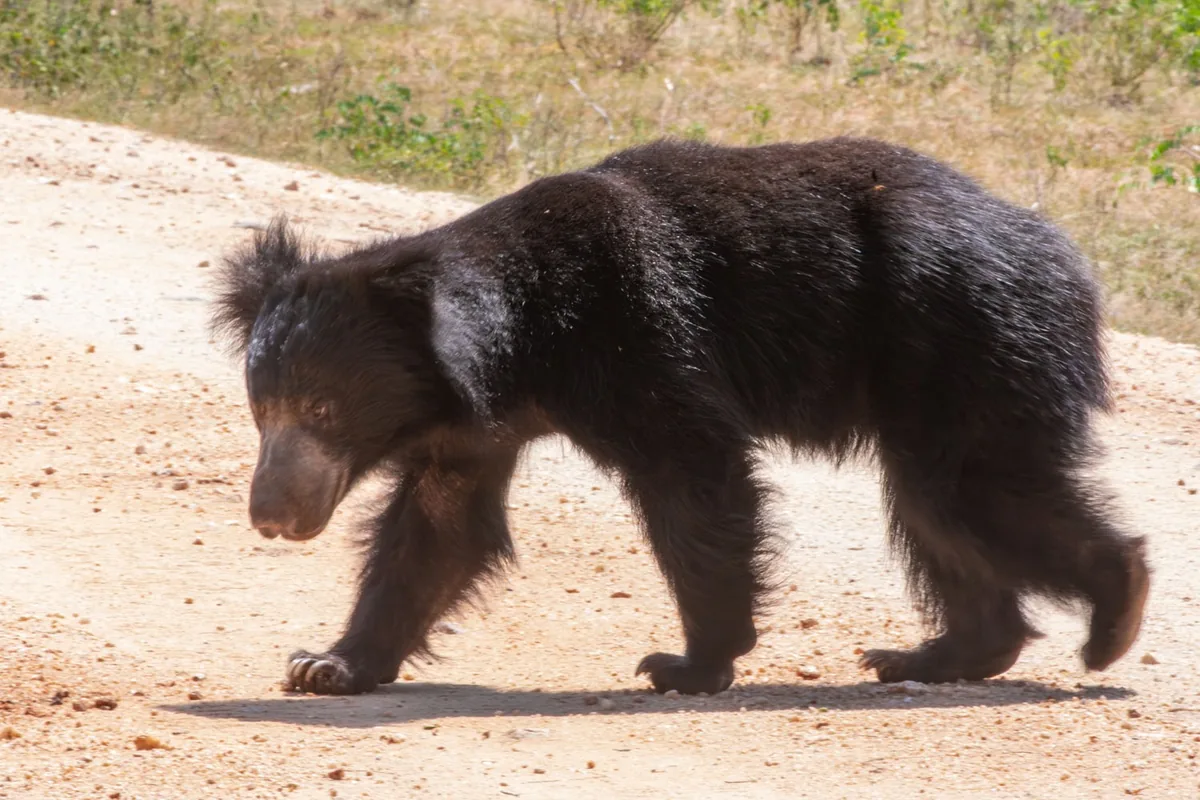
A Sri Lankan sloth bear crossing a sandy track
03 Sri Lanka · Ongoing

Sri Lanka Tracker Mentorship & Certification

Sri Lanka currently has no guide or tracker certifications. The Foundation builds the country's tracker community in two ways. First, by traveling to Sri Lanka to conduct training and certification so guides and trackers can certify on home soil, while mentoring top candidates to organize their own professional guiding body and a uniquely Sri Lankan tracking award system that feeds into CyberTracker certification and Evaluatorship. Second, by funding candidates' travel, accommodation, and program costs to attend training and certification in countries where CyberTracker is already established, accelerating their advancement toward the highest levels of certification, instruction, and understanding.

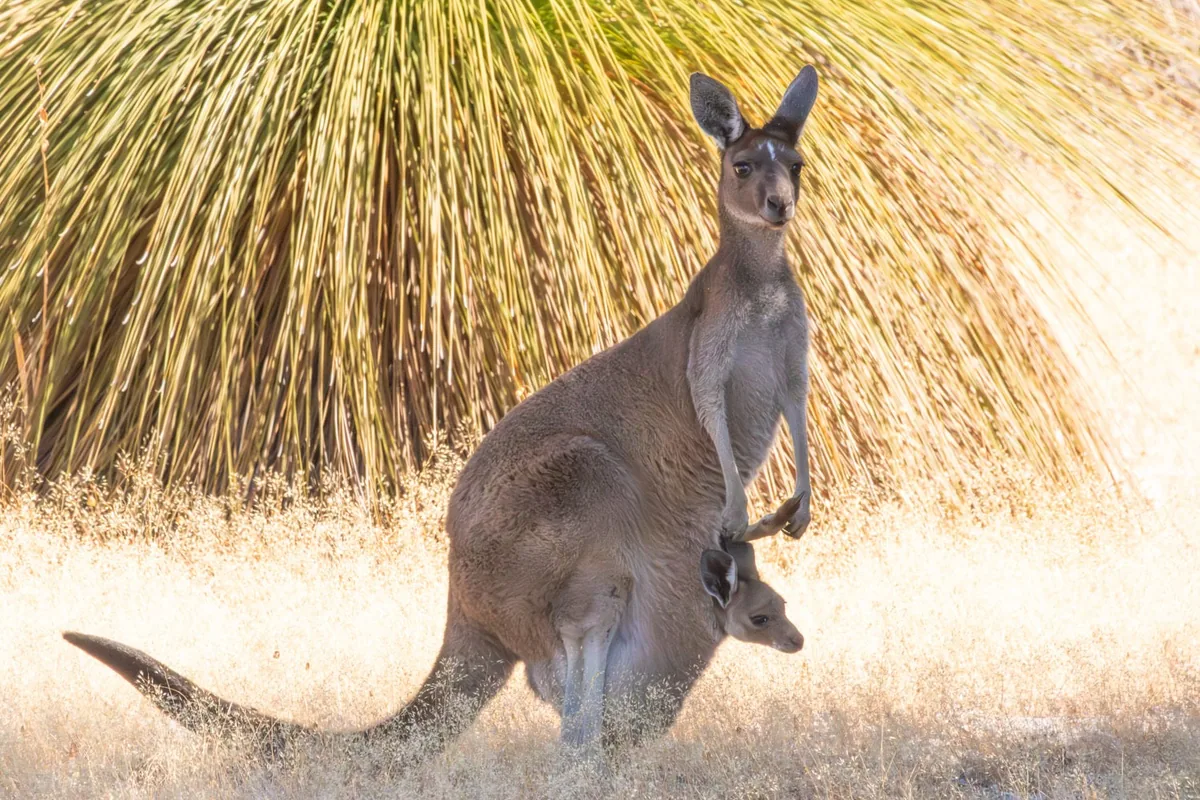
A kangaroo with a joey in its pouch in the Australian bush
04 Australia · Ongoing

Australia Tracker Mentorship

The Foundation is traveling to Australia to provide in-context process instruction, and bringing high-level trackers to South Africa for training and increased certification opportunities. The work focuses on reaching Aboriginal peoples, supporting candidates toward Senior Tracker and Evaluator certification.

05 West & East Africa · Proposed Nov 2027

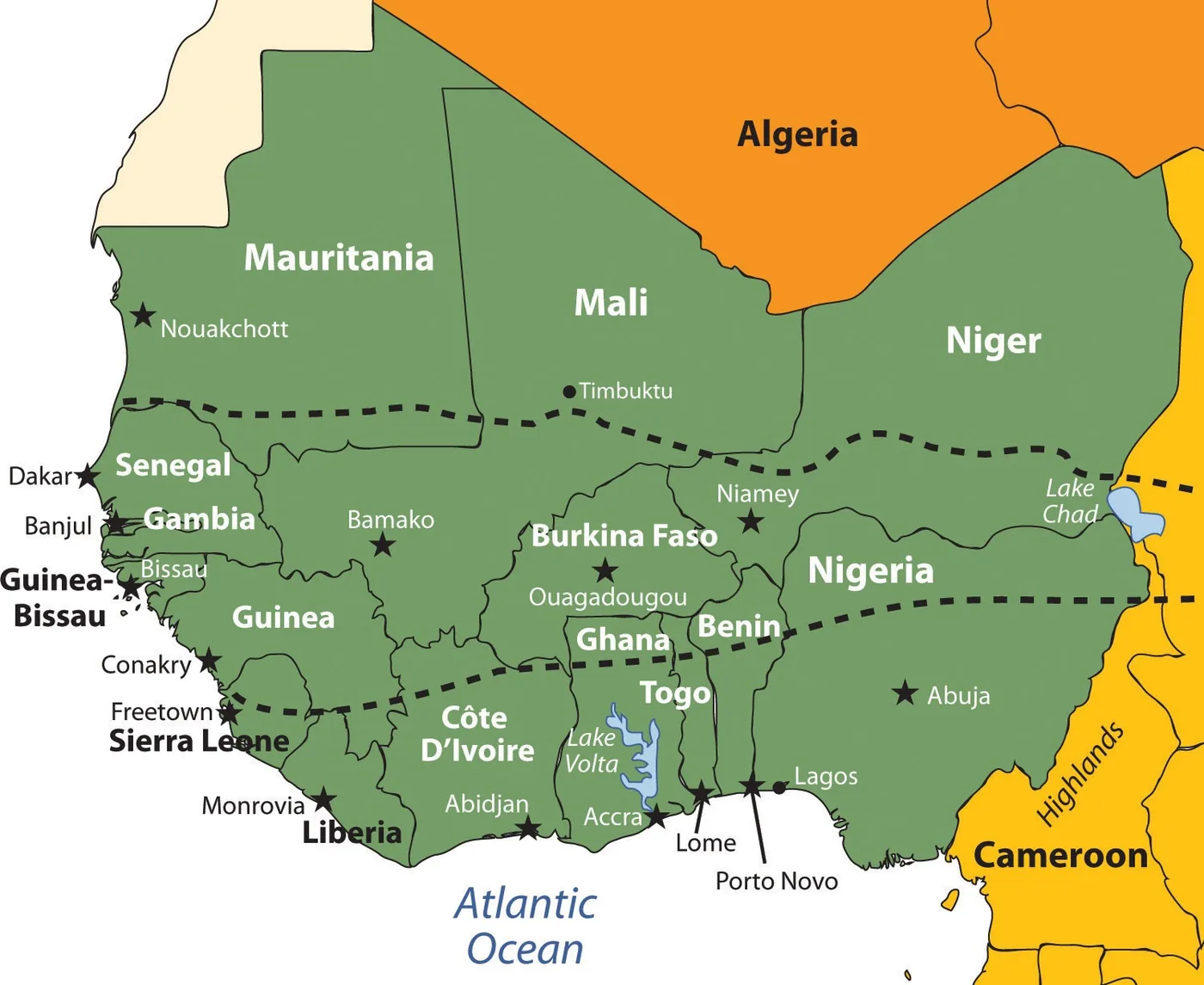
West & East Africa Project

A proposal for November 2027 to work with local people from Nigeria and Ghana in West Africa, and Tanzania in East Africa. The program would work with local communities and with students and faculty at Kwame Nkrumah University of Science and Technology (KNUST) in Kumasi, Ghana, and Federal University Dutse (FUD) in Jigawa State, Nigeria, and would deliver the first tracker training and CyberTracker certifications in West Africa.

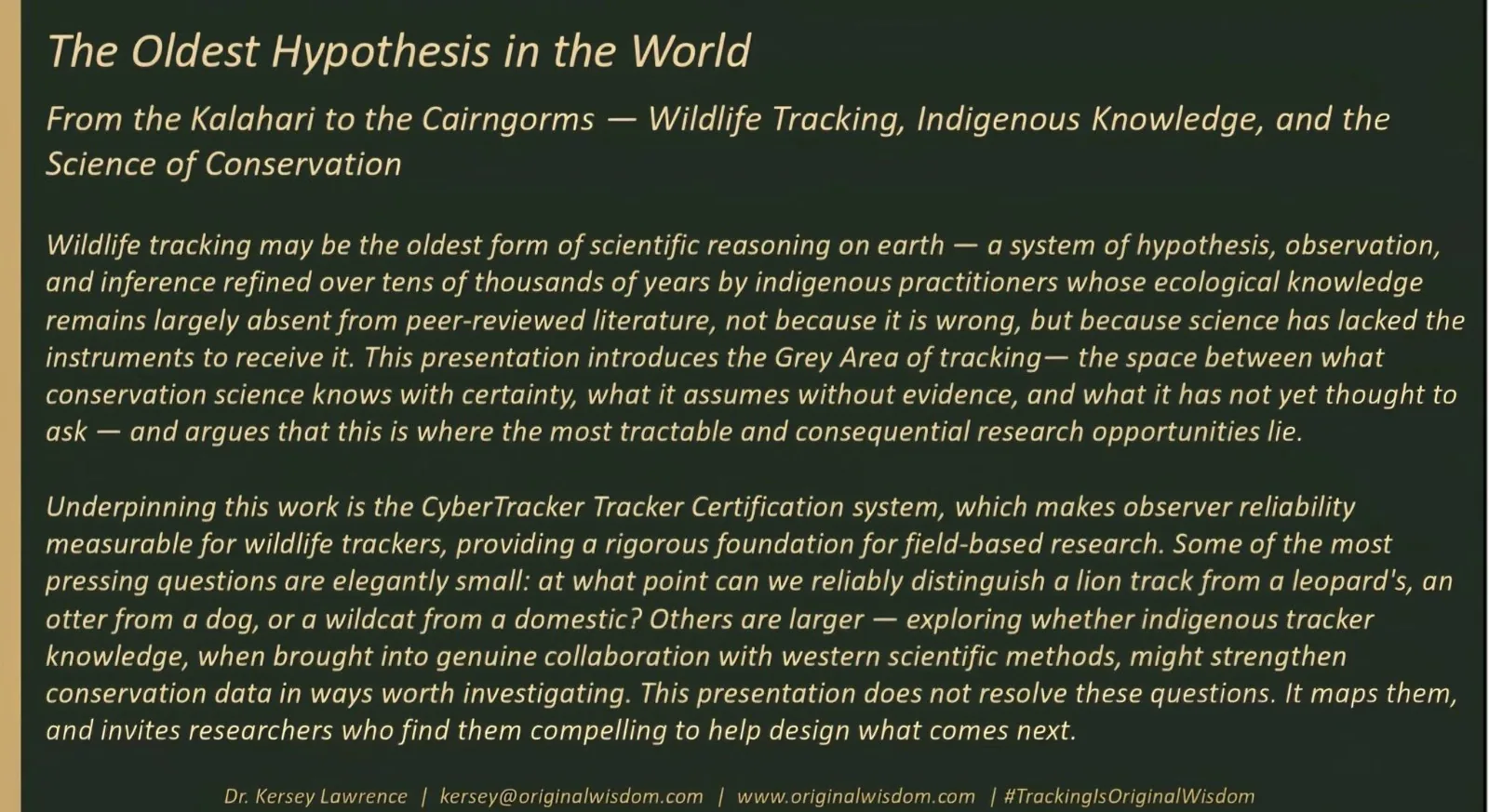
Presentation slide by Dr. Kersey Lawrence, The Oldest Hypothesis in the World, on wildlife tracking, indigenous knowledge and conservation science
06 Scotland · Active

University of Aberdeen Collaborative Research Program

In partnership with the University of Aberdeen, where Dr. Lawrence is Honorary Faculty, researching the reliability and validity of track, sign identification and trailing for conservation monitoring, and comparing certified trackers with various technologies and innovations, such as camera traps, eDNA and WildTrack. The work is not purely comparative: the aim is to understand how technologies and innovations, combined with certified tracker skills, can yield better data and results. The approach is collaborative, not competitive, some cases may favor one method over another, and part of the value is recommending the right approach for the circumstances. A parallel strand examines indigenous and community ecological knowledge within conservation science. Students at Aberdeen come from home countries across the world; while most projects are expected to center on Scotland and the Kruger Lowveld home base, students wishing to work in other regions are also encouraged to apply.

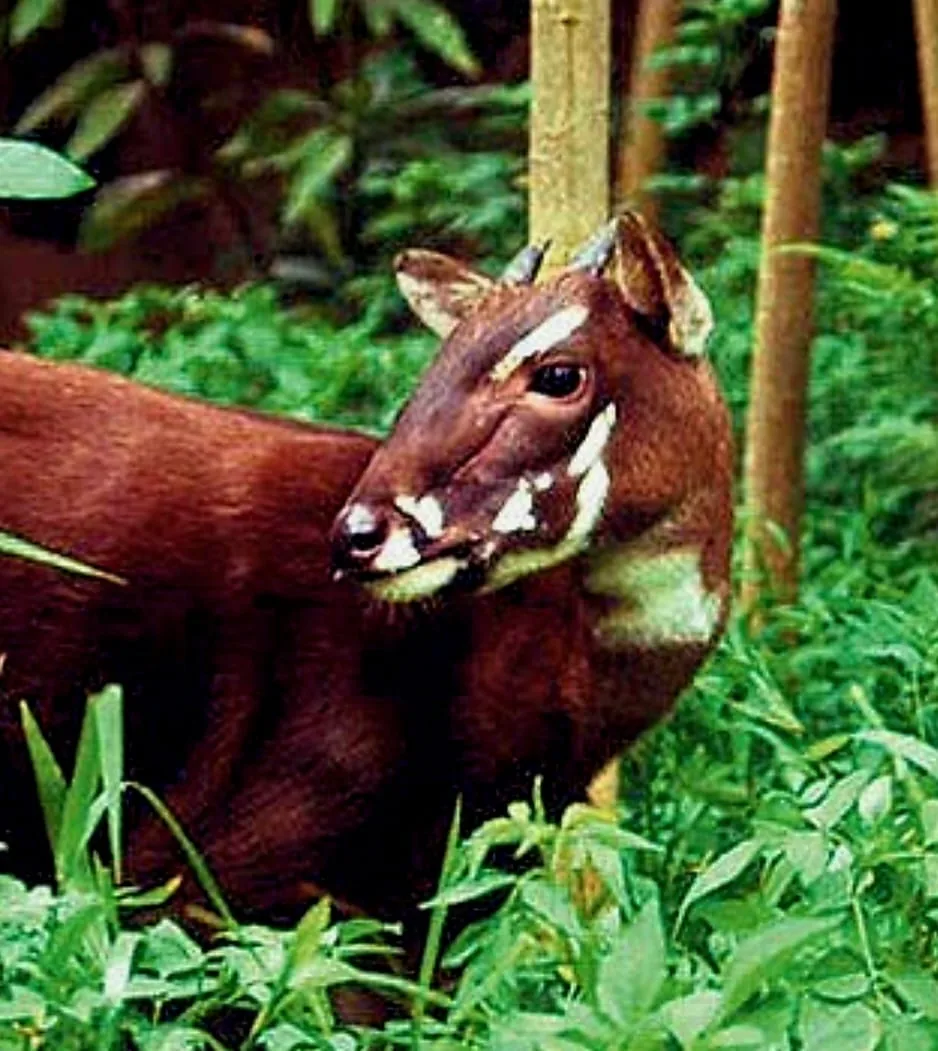
A Saola in the forest, the rare species at the heart of the search in Laos
07 Laos & Thailand · Ongoing

Saola Search, Tracker Training & Conservation of the Annamite Mountains, Laos & Thailand

Work with the Saola Foundation began with discussions in 2019, materializing in the first trip in November 2022. As CyberTracker certified Senior Tracker/Evaluators and guide trainers, Lee and Kersey were asked to assist with the search for the Saola in the mountainous rainforest of Laos's Annamites, and to help select trackers for future employment by the Saola Foundation. They developed a training and selection plan; Lee spent 30 days in the jungle assessing 16 Laotian candidates, seven of whom were selected by the Saola Foundation. For this 2022 engagement, Lee was paid a small salary in addition to his travel and accommodation.

Kersey and Lee returned in May 2024, traveling to Thailand, where the Saola Foundation's tracker and technical team joined them in Khao Yai National Park for Track & Sign training, a strategic choice offering clear tracks and visible animals to study in an already-functioning conservation model, conditions difficult to find in the rugged Annamites. For the 2024 work, Kersey and Lee donated their time; the Saola Foundation covered only their travel and accommodation. As project coordinator for CyberTracker, Kersey also helped place two additional high-level trackers in Laos and Thailand in 2024 and 2025. There is a proposal for Kersey to teach a workshop at the National University of Laos (NUOL) in Vientiane, Laos.

The search combines wildlife trackers with scent-detection dogs and scat-based DNA analysis. One possible set of Saola tracks was found in 2023, though no scat sample was recovered to confirm it; local villagers report continued sightings, and a backlog of collected scat samples may yet confirm the species' continued existence. In the meantime, the Saola Foundation's work is employing local people and raising awareness across the Annamite mountain range, an area of major conservation importance, biodiversity, and ongoing species discovery. Lee has written a first draft manual on the Tracks and Signs of the region and invited trackers to contribute as co-authors.

The Saola Foundation has covered the travel and accommodation for this work to date. The Foundation proposes to bring eligible tracker team members (those able to obtain passports and visas) to South Africa for an intensive training period, covering travel, accommodation, and program costs.

Saola photo courtesy of the Saola Foundation.
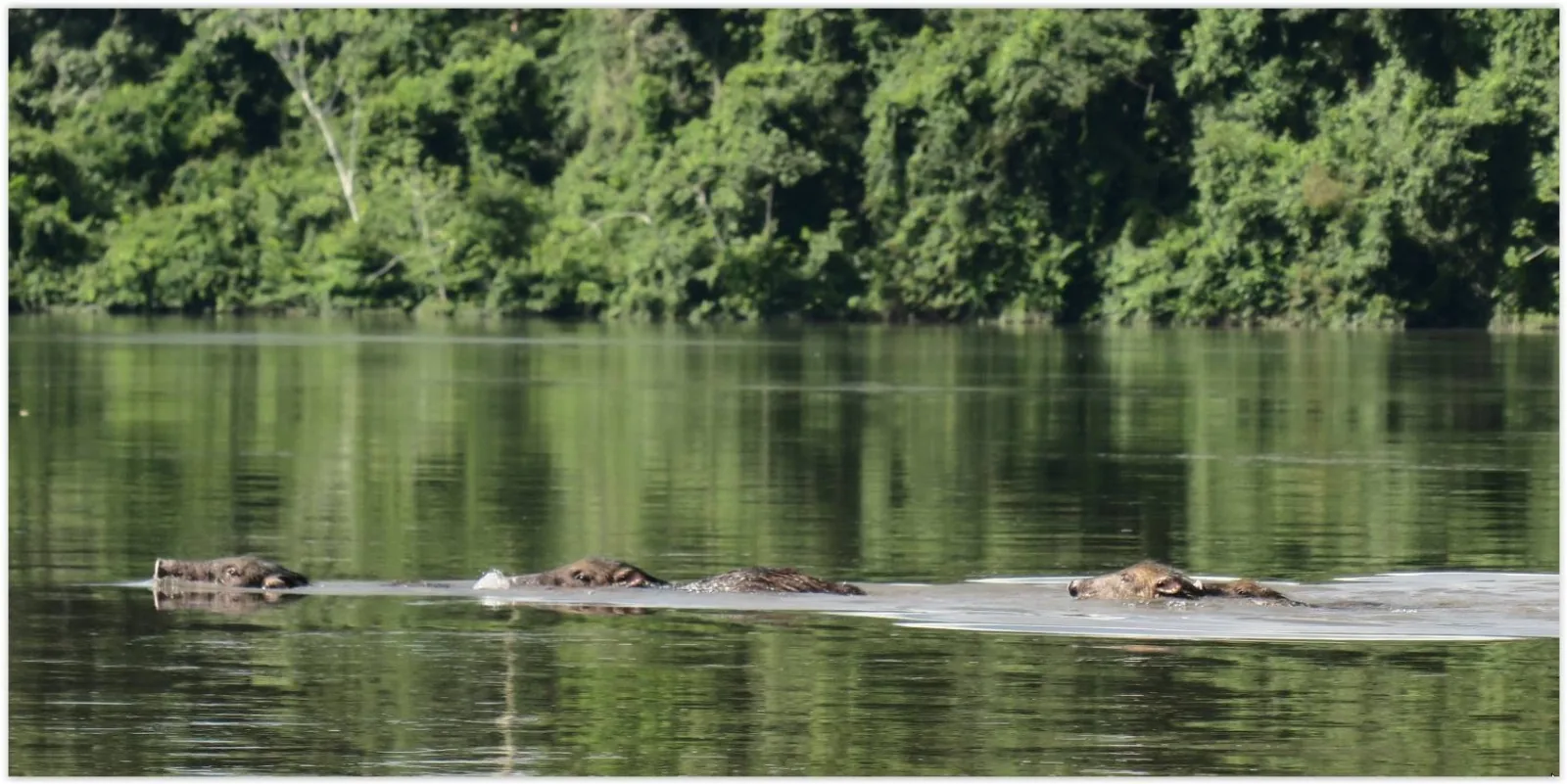
White-lipped peccary swimming across the Amazon river

White-lipped peccary swimming across the Amazon river, by Juarez Pezzuti

08 South America · Developing

Amazon Community Wildlife Management Partnership, Brazil

A developing partnership with Dr. Juarez Carlos Brito Pezzuti, Associate Professor of Ethnobiology at the Federal University of Pará, one of the largest universities in northern Brazil and globally recognized for its research on the Amazon. Dr. Pezzuti's work centers on ethnozoology and community-based wildlife management through participatory research.

Dr. Pezzuti, Juca, as he is affectionately known to us, is a graduate of our programs and a certified tracker in South Africa. We envision a project that brings together two kinds of knowledge. Juca offers deep connections with local people, and their knowledge of the region, wildlife, and culture. We offer years of international experience, and the ability to turn that experience into hands-on education. Together, this becomes a program that trains and certifies new trackers. We do this through training designed specifically for local people, where we often learn as much as we teach. We also bring in a small group of international trackers. We are planning to launch a pilot for this in 2028.

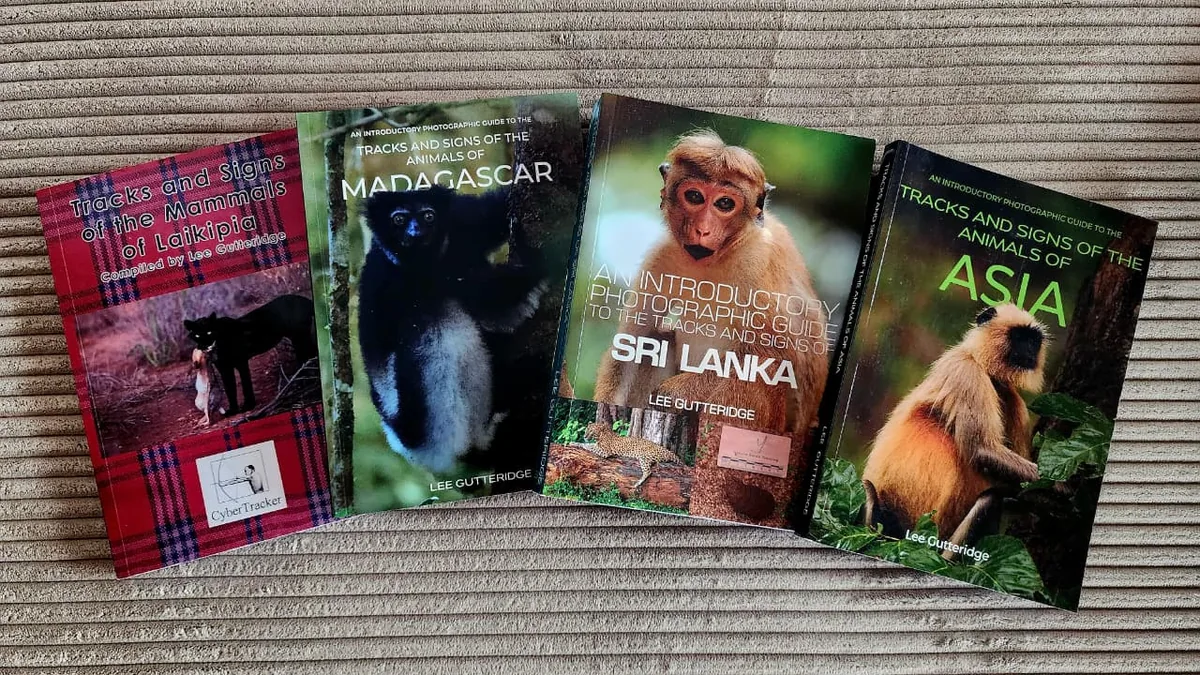
Photographic regional tracking manuals by Lee Gutteridge: Tracks and Signs of the Mammals of Laikipia, plus guides to Madagascar, Sri Lanka and Asia
09 Multiple regions · Ongoing

Regional Tracking Manuals

When traveling to a new region, it's important to give trainees a regional reference to support their learning, especially where one doesn't already exist. As a measure of his commitment, Lee Gutteridge has produced photographic regional manuals for many of the places where he and Kersey travel to train and certify trackers. These manuals have historically been written, printed, transported, and donated to local trackers free of charge, at Lee and Kersey's own expense. Examples include Laikipia, Kenya; South Asia (Laos, Thailand, and India); Sri Lanka; and Madagascar. In some of these regions, local trackers are now picking up the torch, inspired to draft their own regional guides.

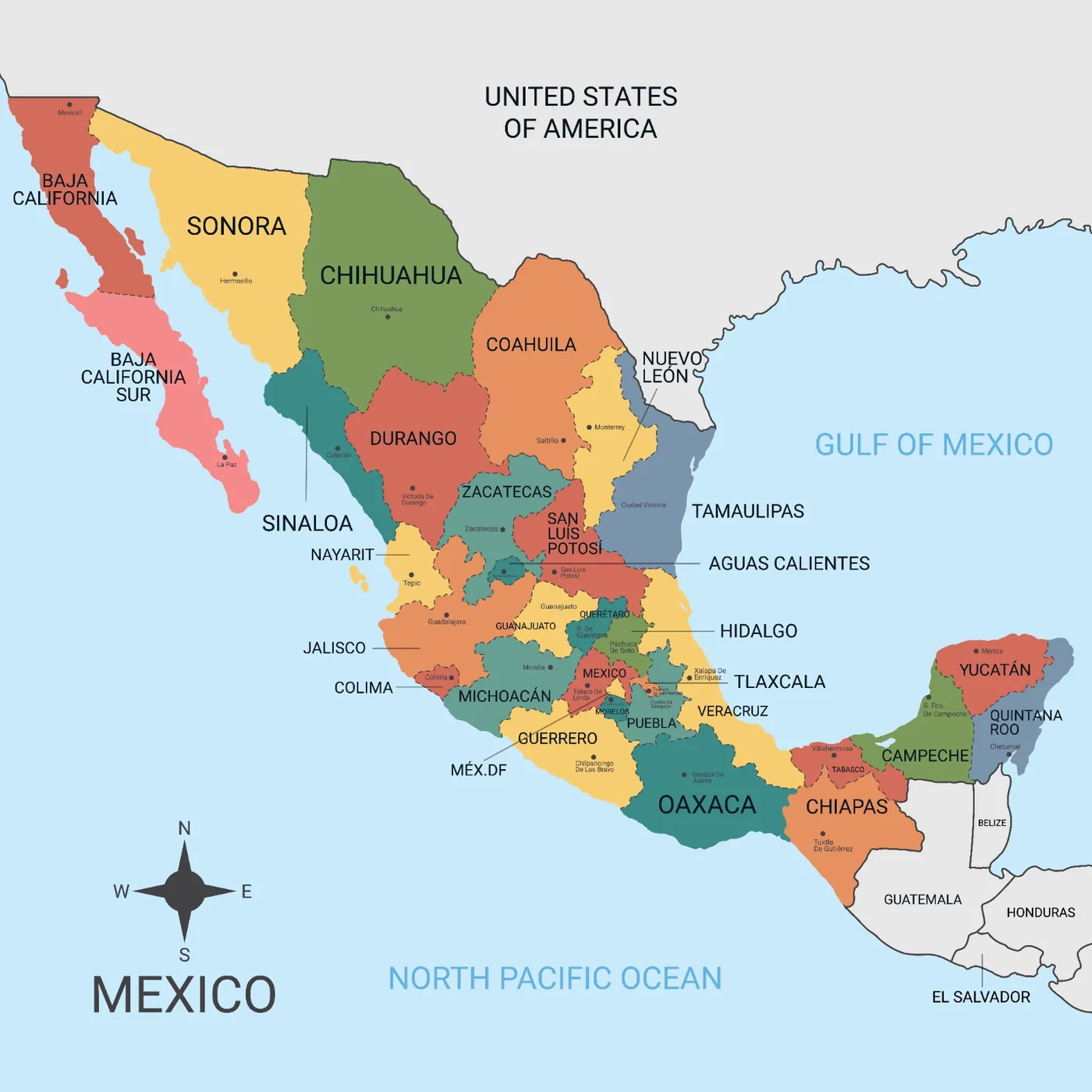
Map of Mexico and its states, where the bilingual Tracks and Signs field guide is researched

Map courtesy of Vecteezy

10 Mexico · Planned 2027

Tracks and Signs of the Wildlife of Mexico Field Guide

A bilingual (English/Spanish) illustrated guide documenting track and sign identification across Mexico's ecosystems. Lead author and artist: Jennifer Draime. Co-author: Dr. Kersey Lawrence. Contributing photographer: Lee Gutteridge. Field research begins 2027. Authors retain copyright and royalties; the Foundation funds field travel, equipment and a publication contribution.

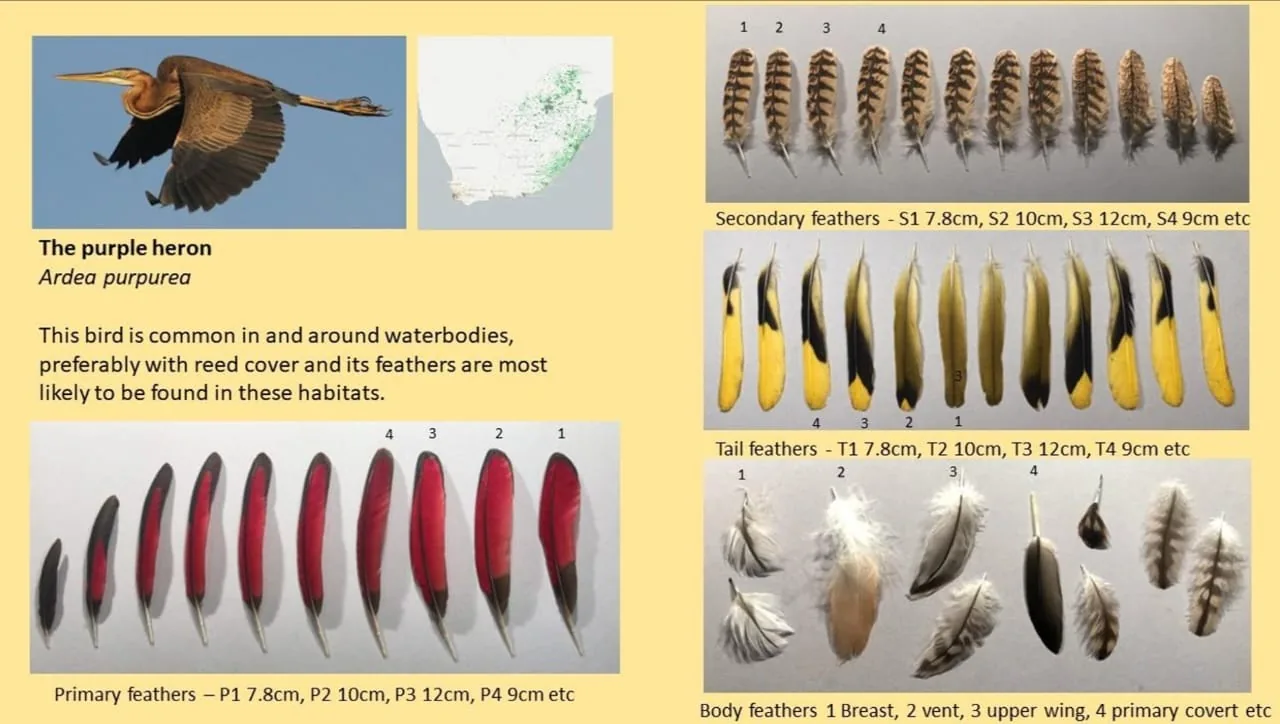
A page from the Bird Feather Book documenting and measuring the purple heron's primary, secondary, tail and body feathers
11 South Africa · In progress

The Bird Feather Book

Co-authored by Lee Gutteridge and Kersey Lawrence, a visually stunning documentation of the feathers of South Africa's birds, under construction since 2016. The long timeline reflects the ethics of the work: no animals are killed for species information. Only specimens that have died from natural causes, such as home-window strikes and vehicle collisions, are used. Approximately 300 species have been photographed so far, with information on males, females, juveniles and color morphs, with many of their feet and skulls also being documented. We are ready to begin laying out the book while continuing to photograph new specimens, and welcome volunteer assistance.

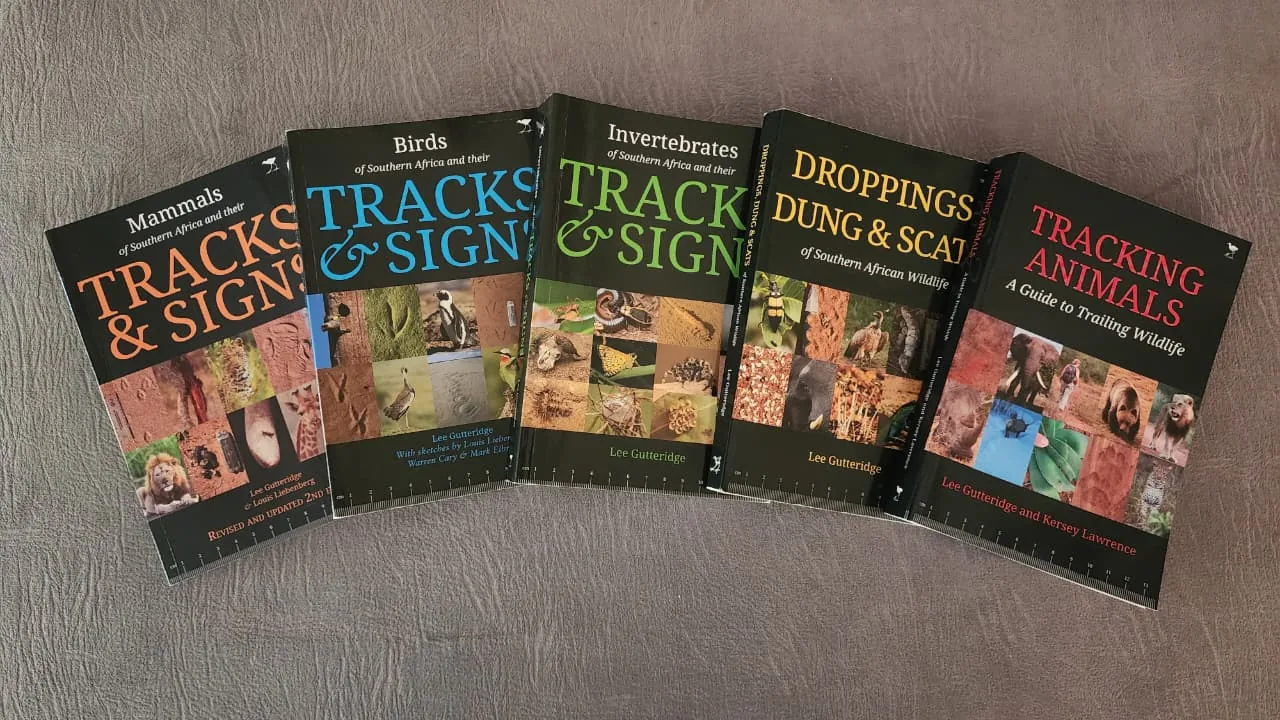
The Tracks and Signs book series by Lee Gutteridge with Jacana Media: Mammals, Birds, Invertebrates, Droppings Dung and Scat, and Tracking Animals
12 South Africa · Upcoming

Reptiles and Amphibians of Southern Africa: Tracks & Signs

Co-authored by Lee Gutteridge and Kersey Lawrence, this volume continues the track-and-sign book series Lee has authored with Jacana Media, beginning with Mammals (with Louis Liebenberg), then Birds, Invertebrates, Droppings & Scats, and Tracking Animals (with Kersey Lawrence). It will document and add to what is known about South Africa's reptile and amphibian life, and their tracks and signs.

Questions

About this work

What is CyberTracker certification?

CyberTracker is the global standard for evaluating wildlife-tracking skill. Trackers are assessed and certified through levels up to Senior Tracker and Evaluator, the highest qualifications in the field. The Tracker Empowerment Foundation funds and mentors trackers toward these certifications. Learn more about CyberTracker.
What is a Senior Tracker or Evaluator?

A Senior Tracker holds CyberTracker's highest tracking certification. An Evaluator is qualified to assess and certify other trackers. Building Evaluators in each region lets communities certify their own trackers independently.

Where does the Tracker Empowerment Foundation work?
Across the world, on every continent except Antarctica. Current projects span Southern Africa, Sri Lanka, Australia, West and East Africa, Scotland, Mexico, Laos and Brazil.

Does the Foundation work with universities?

Yes. It collaborates with the University of Aberdeen in Scotland, the Federal University of Pará in Brazil, and its proposed West and East Africa program works with Kwame Nkrumah University of Science and Technology (KNUST) in Ghana and Federal University Dutse (FUD) in Nigeria. A workshop is also proposed at the National University of Laos (NUOL).

Partner with us

Work with trackers? Let's talk.

If your organization works with trackers, guides, conservation projects or communities, we'd love to find ways to support the people doing the work. Reach out and tell us what you're building.

Get in touch

Get involved

Want to make more of this work possible?

Every contribution helps seat another tracker at the table, fund another mentorship, and back the science that proves what trackers already know.

Donate